
The days of an orange EKG trace running across a black background on the display of a 30 lbs patient monitor are long gone.
Looking back at yesteryear, we pulled an old monitor out of the warehouse and placed it next to a new Biolight A5 Anyview monitor to see the differences side by side. We used an old Datascope 3000 patient monitor, which was an extremely popular monitor some 20 years ago. It was well built, reliable, and we sold and serviced many of those units in years past. Today the Datascope 3000 monitor is obsolete, but serves as a good comparison to 20 years of patient monitoring progress. We compared just some of the basic characteristics in the examples below.
Display:
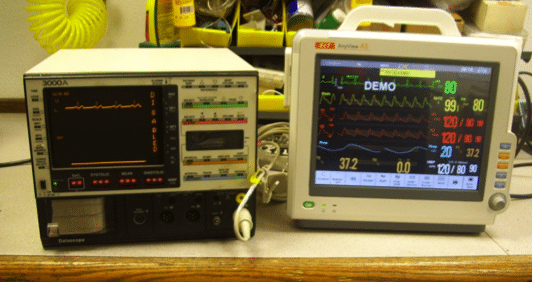 How far we have come in only 20 years or so. The technology, design, and user interfaces have changed dramatically in a relatively short time period. The colorful LCD display of the Biolight monitor is large, easy to read, and the colors correspond to individual parameters and serve as a reference point when checking the patient’s condition.
Weight:
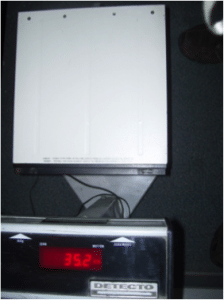 35 lbs! This was a heavy monitor with a metal case. Mounting options were available, but imagine the weight of this monitor crashing to the floor if there was a mishap!
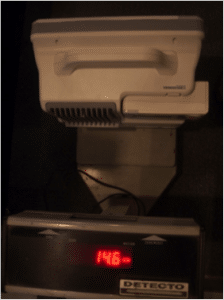 The Biolight patient monitor is only 14.6 lbs. Easy to carry and transport, if needed.
Dimensions:
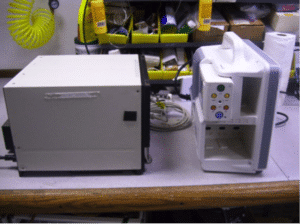
Not surprisingly, the Datascope 3000 comes in at a whopping 13” wide, while the Biolight A5 comes in at under 8” wide. This makes it much easier to mount and even transport the monitor.
Menus/Interface:
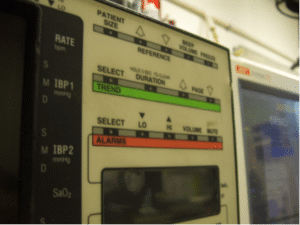
The menus on the 3000 patient monitor were mainly on the face of the unit, and the user was limited to what could and could not be changed.
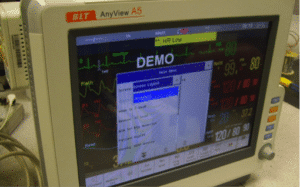
The menus on newer patient monitors are highly customizable and have an enormous amount of options and choices for the user to select from. From entering patient data to drug calculations, these patient monitors can do it all.
Conclusion
It’s no surprise that over the years patient monitors have become more compact, less heavy and more advanced technologically. It is just good to look back sometimes to remember what was “state of the art” for its time, even though it really wasn’t that long ago. Imagine where we might be in another 20 years of advancement in patient monitoring.
Thanks for reading,
